REISift Case Study: Growth Through Adaptation, Community, and Strategic UX

Turning a List Stacker into a powerful Real Estate CRM

Overview

In 2020, I joined a real estate investor platform that had established itself as a list-stacking tool. The project aimed to evolve from a single-feature product into a comprehensive CRM solution that would serve as the primary platform for real estate investors.

The initiative faced significant challenges: there was no dedicated design team, no design research infrastructure, and no telemetry data to inform decision-making. Despite these constraints, the business objective was clear—increase monthly recurring revenue (MRR) by becoming a single, unified solution for users.

Goals

  1. Transform the product architecture - Evolve from a list-stacking tool to a full-featured CRM that could serve as a single solution for real estate investors
  2. Increase monthly recurring revenue (MRR) - Drive business growth through expanded functionality, improved user retention, and platform consolidation
  3. Establish a UX research foundation - Build a comprehensive UX database to map future features to ideal customers, enable faster collection of quantitative and qualitative data, and establish smoother product design cycles
  4. Increase engagement by improving the frequency and quality of reviews to support business goals.
Role
Lead Designer
Responsibilities
Sole designer from 2020 through acquisition. I owned the entire UX process: user research, journey mapping, competitive analysis, interaction design, prototyping, and validation.
Collaborators
Stakeholders, Customer Support, Customer Success, and Engineering.
Timeline
Jan 22 - Mar 25

Business problem

The platform had established itself as a list-stacking tool but was limited to a single feature in a market where users needed comprehensive solutions.

Without design research infrastructure or telemetry, the company lacked data-driven insights to guide product decisions. This narrow focus limited revenue potential and made the platform vulnerable to competitors offering more complete solutions.
Business Need
The company needed to increase MRR by expanding product capabilities beyond list-stacking and position itself as a single, unified solution to reduce user churn and increase platform stickiness.

User problem

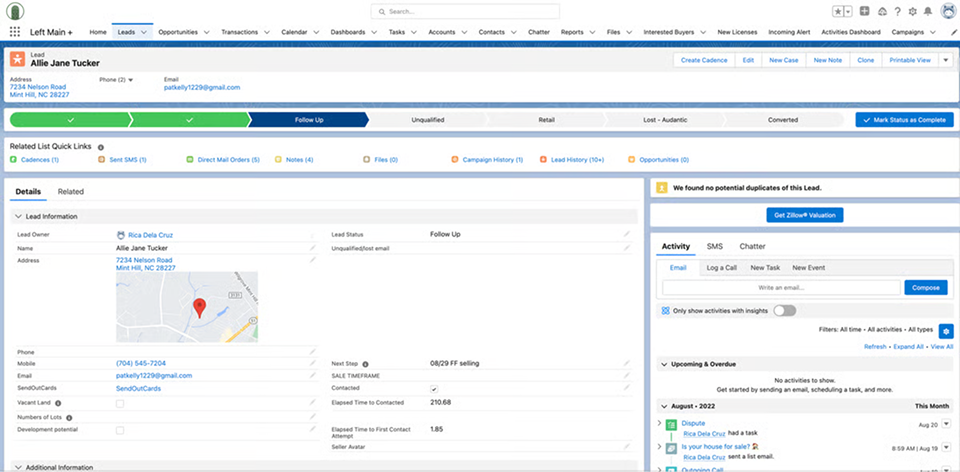
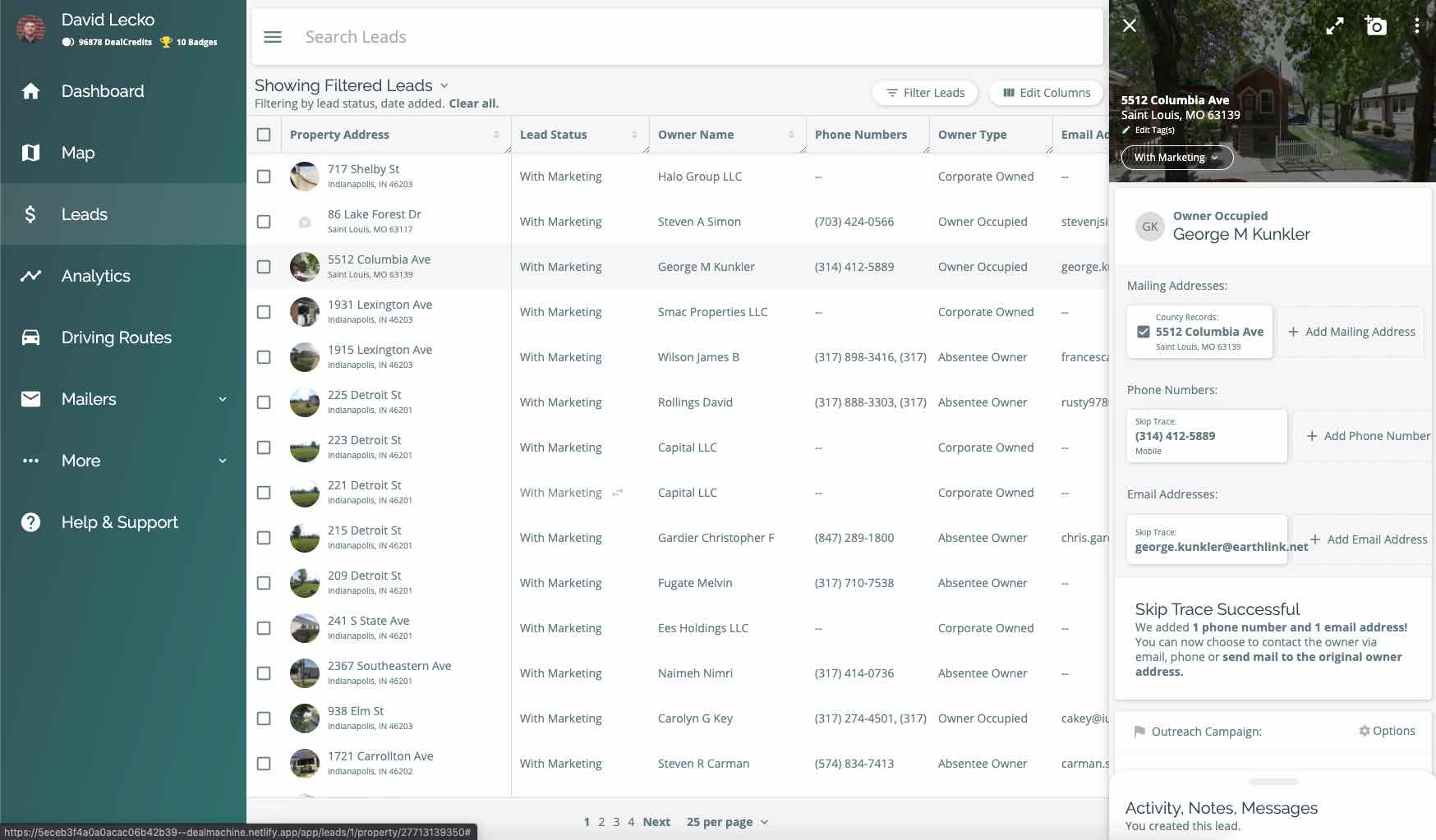
Real estate investors were forced to rely on multiple external services to compensate for missing CRM functionality. This fragmented workflow created data integrity issues, as information was lost or corrupted during integrations between different platforms. The constant context-switching between tools slowed down their work and introduced friction into critical business processes.
USER Need
Users needed a fully integrated, single-platform solution where all their CRM features worked seamlessly together without requiring external integrations. This would eliminate data loss, reduce workflow friction, and allow them to manage their entire real estate investment process within one cohesive environment.
problem to solve

Transform a single-feature list-stacking tool into a comprehensive CRM platform that increases business revenue while meeting users' workflow needs.

RESEARCH

Competitive analysis

I analyzed over 10 direct and indirect competing products to gather insights on how they approached four core workflows critical to real estate investors: Building Lists, Marketing Automation, Lead Management and Offer Tracking.
1 LIST BUILDING
Users need to build lists to create targeted prospects for maximum efficiency
2 MARKETING
Users need to automate their marketing to streamline seller outreach
3 Offer tracking
Users need to automate their marketing to streamline seller outreach
4 Lead management
Users need to manage offers to track and manage deals seamlessly.

Recurring Themes

EASY TO INTEGRATE
Competitors focused on connecting with external tools rather than building comprehensive features, forcing users to maintain multiple subscriptions and fragment their workflows.
DEALS AND OFFERS
Most platforms treated deal management as basic pipeline tracking, missing the complexity of real estate transactions where investors juggle multiple simultaneous offers with different terms.
MARKETING AUTOMATION
Competitors prioritized template libraries and batch sending capabilities but overlooked the relationship-building aspect of real estate investing, where timing and personalization drive response rates.
RESEARCH

Addressing the user pain points

Our analysis revealed three critical needs: ease of integration with other services, lead management directly on the platform, and greater clarity in deals. These findings directly influenced which features we would build first.
1 lead management
Users had to rely on third-party apps to manage their leads, and some data would fall through the cracks during exporting and importing.
2 CUSTOMIZABLE WORKFLOW
Users are constantly changing their workflows due to new methods or regulatory changes. They need to be able to swap pieces of their workflow without friction.
3 DEAL CLARITY
Whether a deal was closed or not, users wanted to be able to review what happened to replicate its success or update their workflow for future deals.
How might we

How might we build a comprehensive CRM that serves both existing users and new prospects when every feature decision must be self-funded?

IDEATION

Developing concepts

Guided by research insights from user interviews and shadowing sessions, I iterated on design directions to address the fragmentation investors faced across multiple platforms. Principles like workflow consolidation, data integrity, and operational efficiency informed every aspect of the CRM solution.
From Zero to Hero
We started with a very dedicated and avaialble user base, we had to address their biggest issues first and build the product from the inside-out.
Modular Workflows
Users already depended heavily of third party services, we needed to accomodate those moving pieces onto the new UX flows that we were creating.
Limited Scope
Featured needed to be usable from the get go, if something was too big, it would be broken into smaller "complete" features or ditched.
Reduced friction
The new processes would need to be exportable as well, we coulnt gatakeep the users data to prevent them from leaving, the data needed to be theirs.

Mapping the many sifting journeys

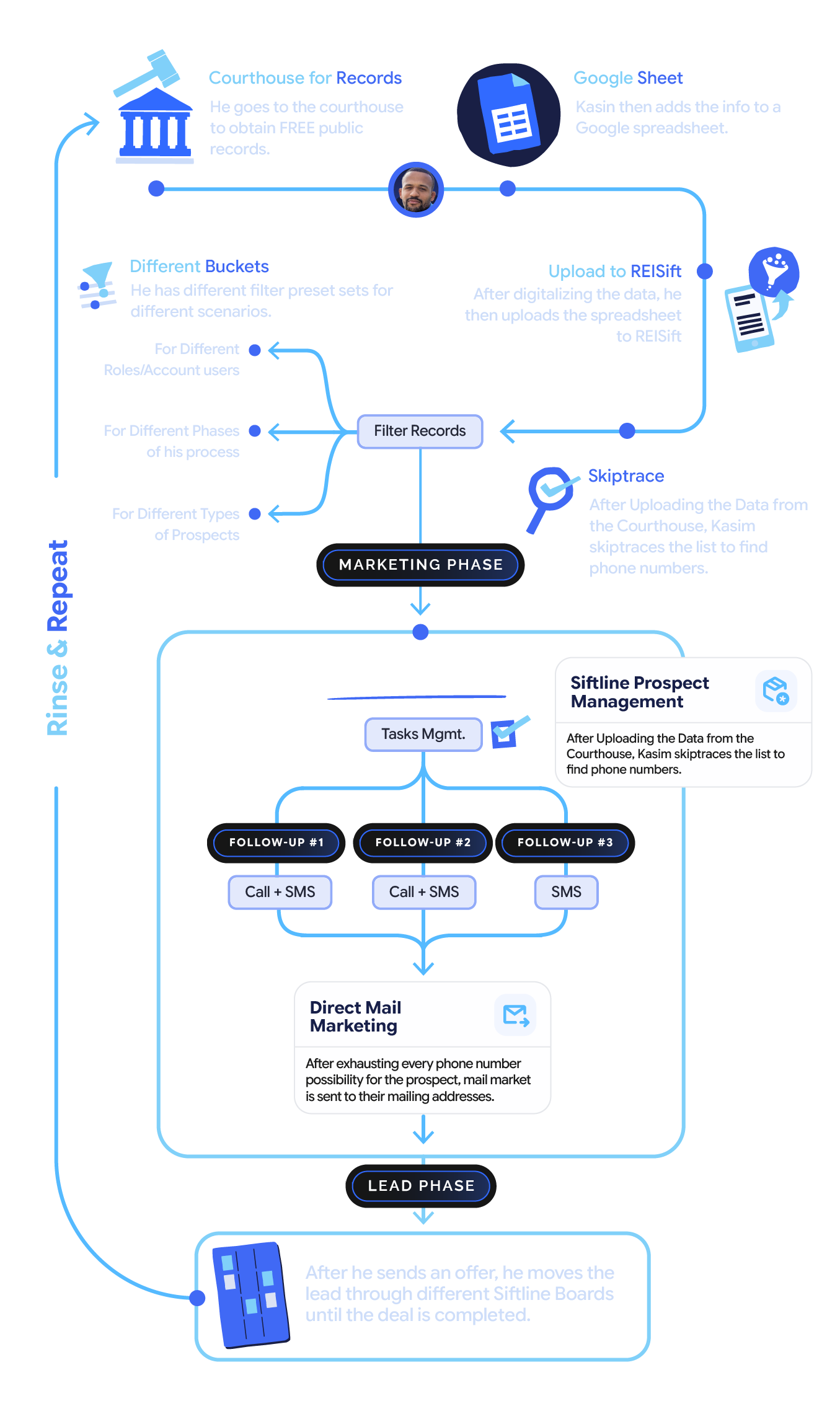
To understand how real estate investors actually worked, we interviewed and shadowed several target users throughout their daily workflows. These sessions revealed critical touchpoints that spanned both digital and physical spaces, from driving neighborhoods to identify distressed properties, to visiting county courthouses for ownership records, to managing spreadsheets for list compilation, to juggling third-party tools for skip tracing, separate platforms for marketing automation, and disconnected systems for offer tracking. By observing these real-world processes that bridged online and offline activities, we identified early wins we could deliver while building toward a comprehensive solution.

From these research sessions, we developed user flows that mapped the investor's end-to-end experience across key operational areas:
  1. Lead Discovery & List Building: Streamline the transition from offline research—driving for dollars, courthouse visits—to digital list compilation, eliminating spreadsheet dependency and manual data entry.
  2. Contact Management: Centralize property owner information gathered from multiple sources and interaction history to maintain data integrity across all touchpoints.
  3. Marketing Automation: Integrate campaign creation and tracking to replace disconnected third-party marketing tools.
  4. Offer Management: Provide end-to-end deal tracking from initial contact through negotiation and closure.
  5. Workflow Integration: Connect previously isolated processes to enable seamless data flow and reduce friction during platform handoffs.

These flows illustrated how data moved between different platforms and physical activities, where friction occurred during handoffs, and which tasks consumed disproportionate time, becoming our foundation for designing integrated workflows within a single unified platform.
Iteration 01
Iteration 02
user testing

Death by a thousand versions

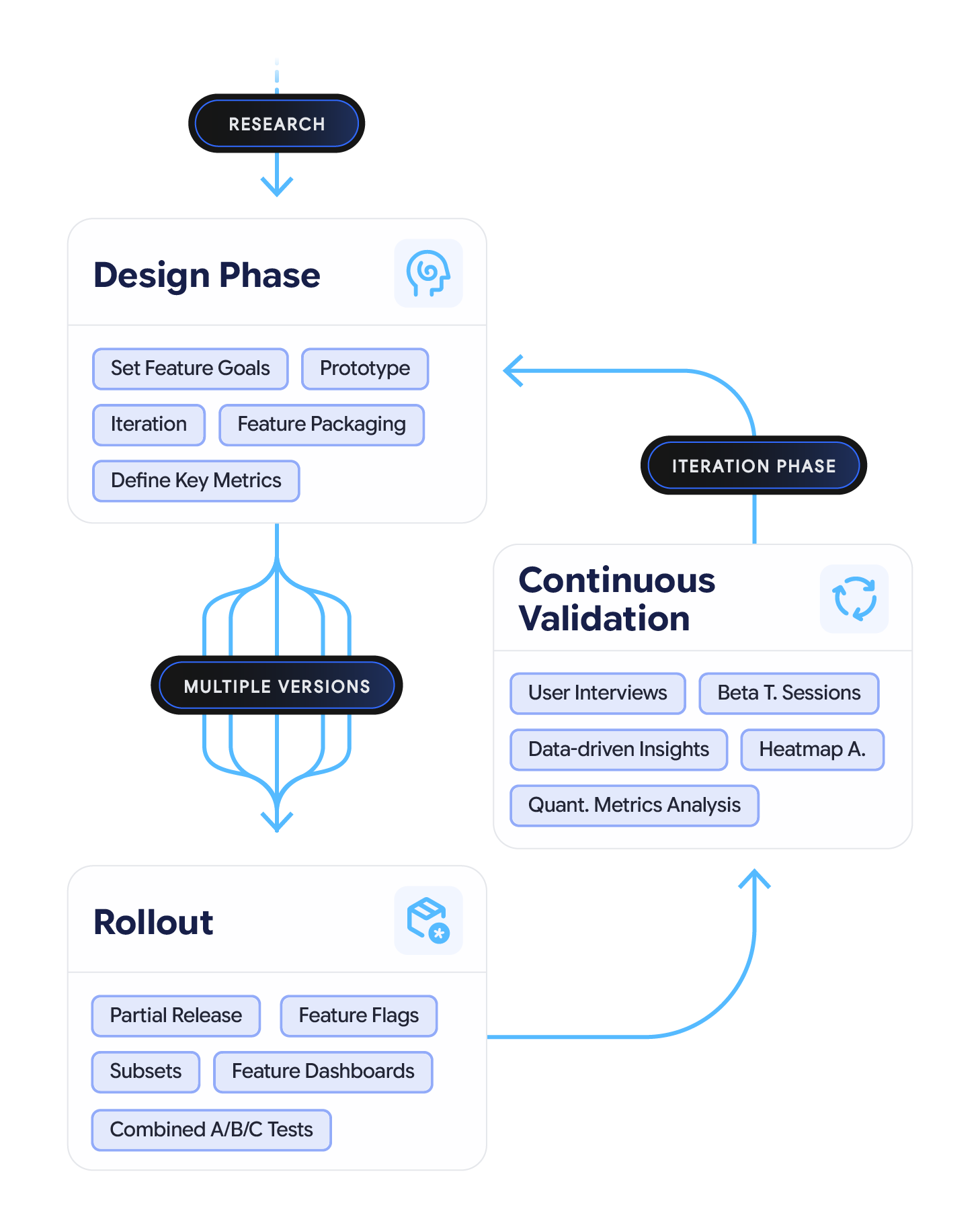
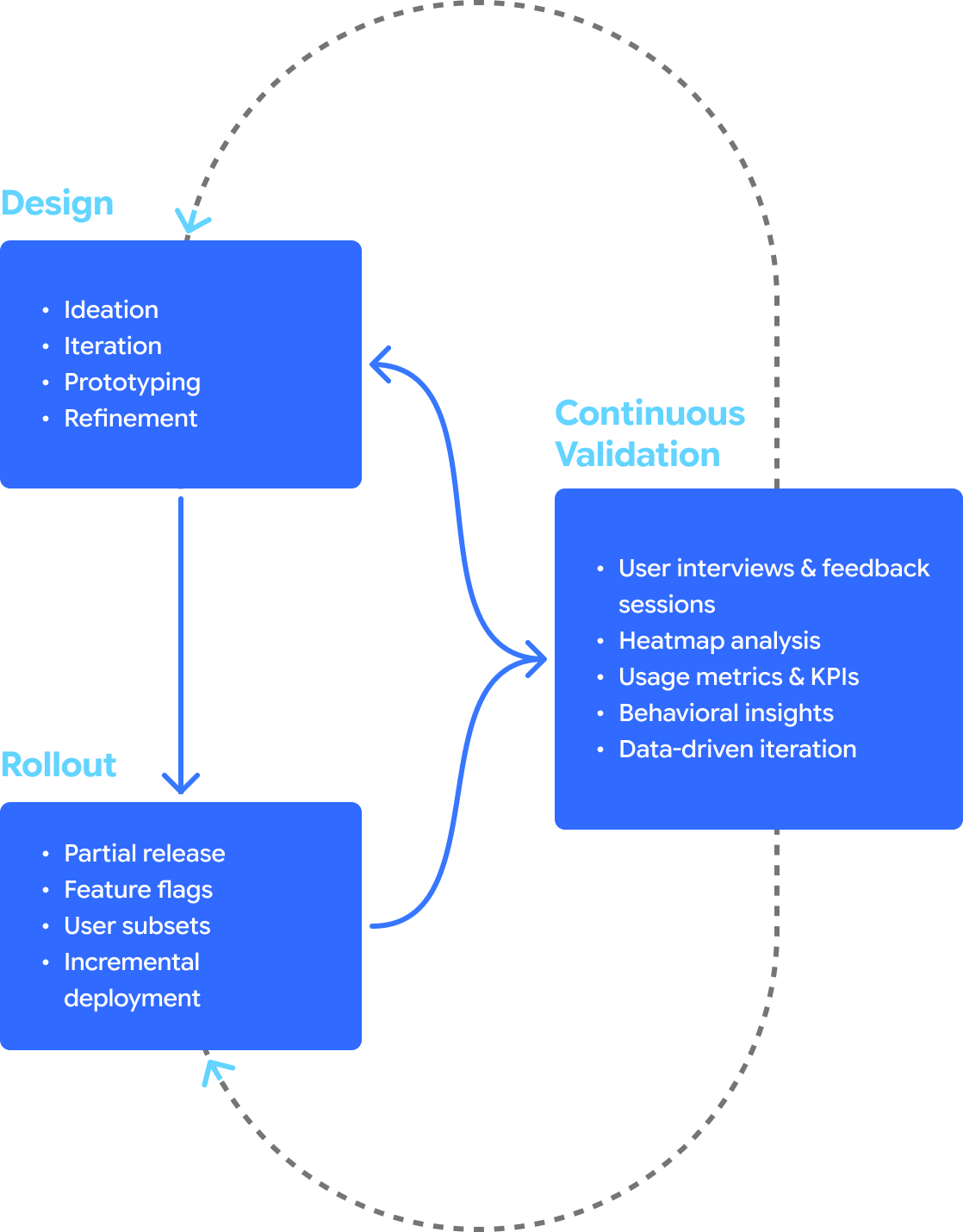
The initial research phase established a foundation for understanding investor workflows and pain points. From there, the design process operated in continuous cycles, with each feature moving through a structured validation framework.

Methodologies used

We explored how to merge the Reviewer Profile and Sampling Program into one cohesive experience.
  1. Specification-First Approach: Every feature began as a written specification document. This allowed quick iteration with stakeholders—changing a paragraph was faster than rebuilding Figma files. Each spec included the feature description, success metrics, and expected impact on adoption and existing workflows.
  2. Controlled Rollouts and Testing: Features launched incrementally, not to everyone at once. The team tested different variations with specific user segments—sometimes comparing versions of the same feature, sometimes testing entirely different approaches. A beta group validated features before wider release.
  3. Metrics-Driven Refinement: Post-launch, the team monitored analytics and Hotjar recordings while conducting unmoderated user interviews. This combination revealed both adoption rates and how features fit into real investor workflows, informing the next cycle.
This cycle repeated throughout the platform's evolution, with each iteration building on insights from the previous round.
PRODUCT

Final Design

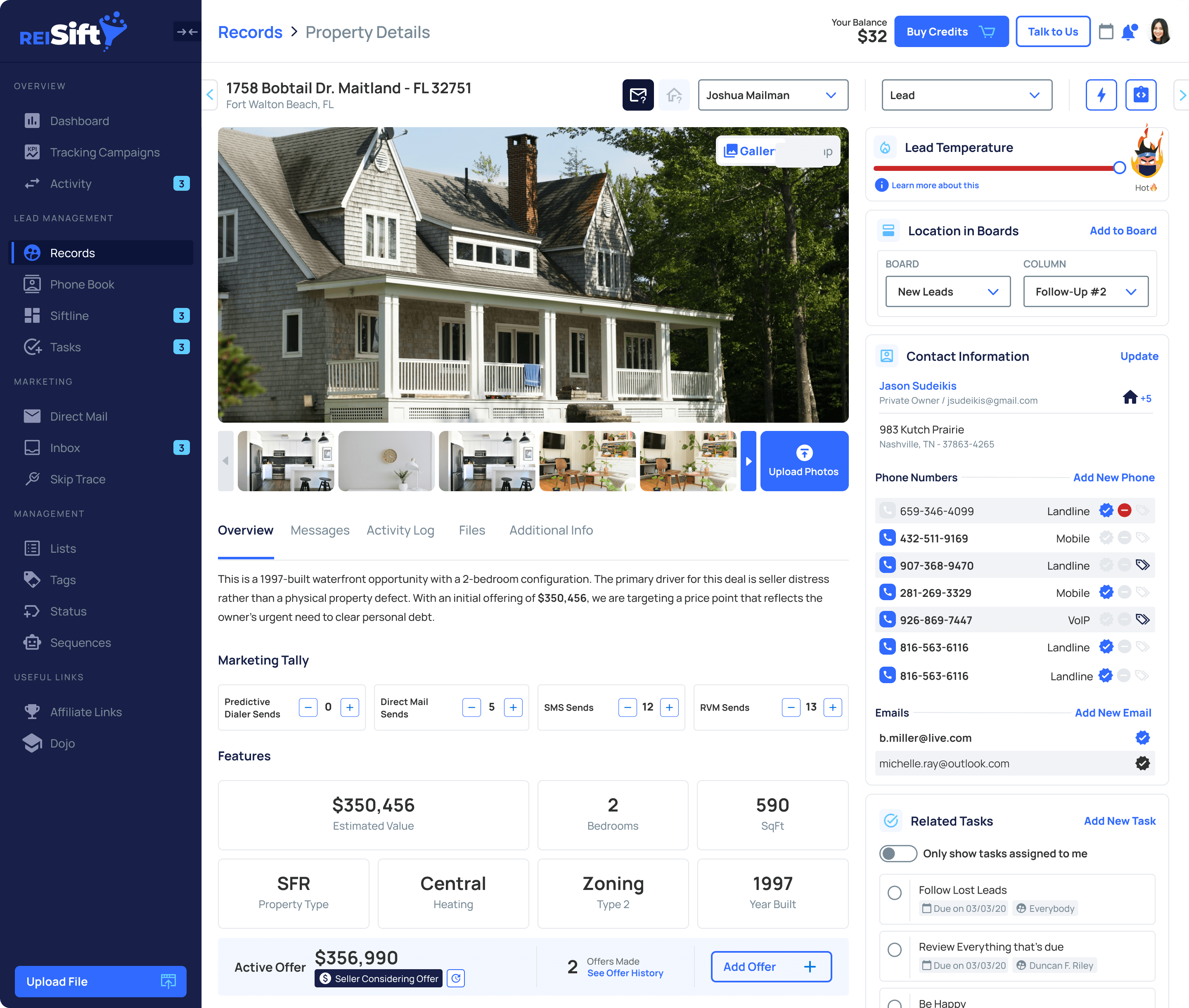
After multiple rounds of testing and refinement, these are the interfaces that were created. Each screen represents either a complete workflow or part of a larger feature, designed to handle complexity without creating friction.
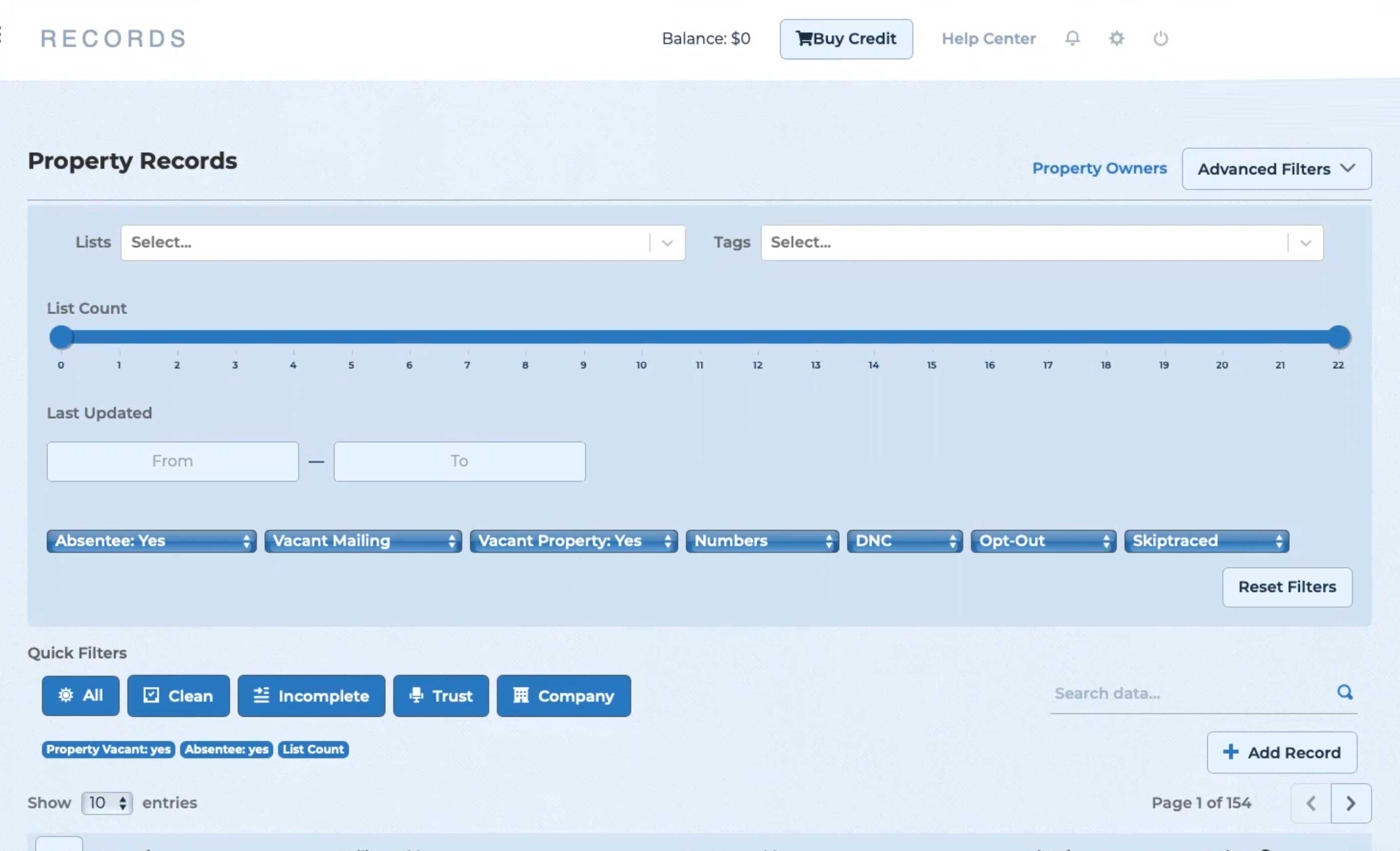
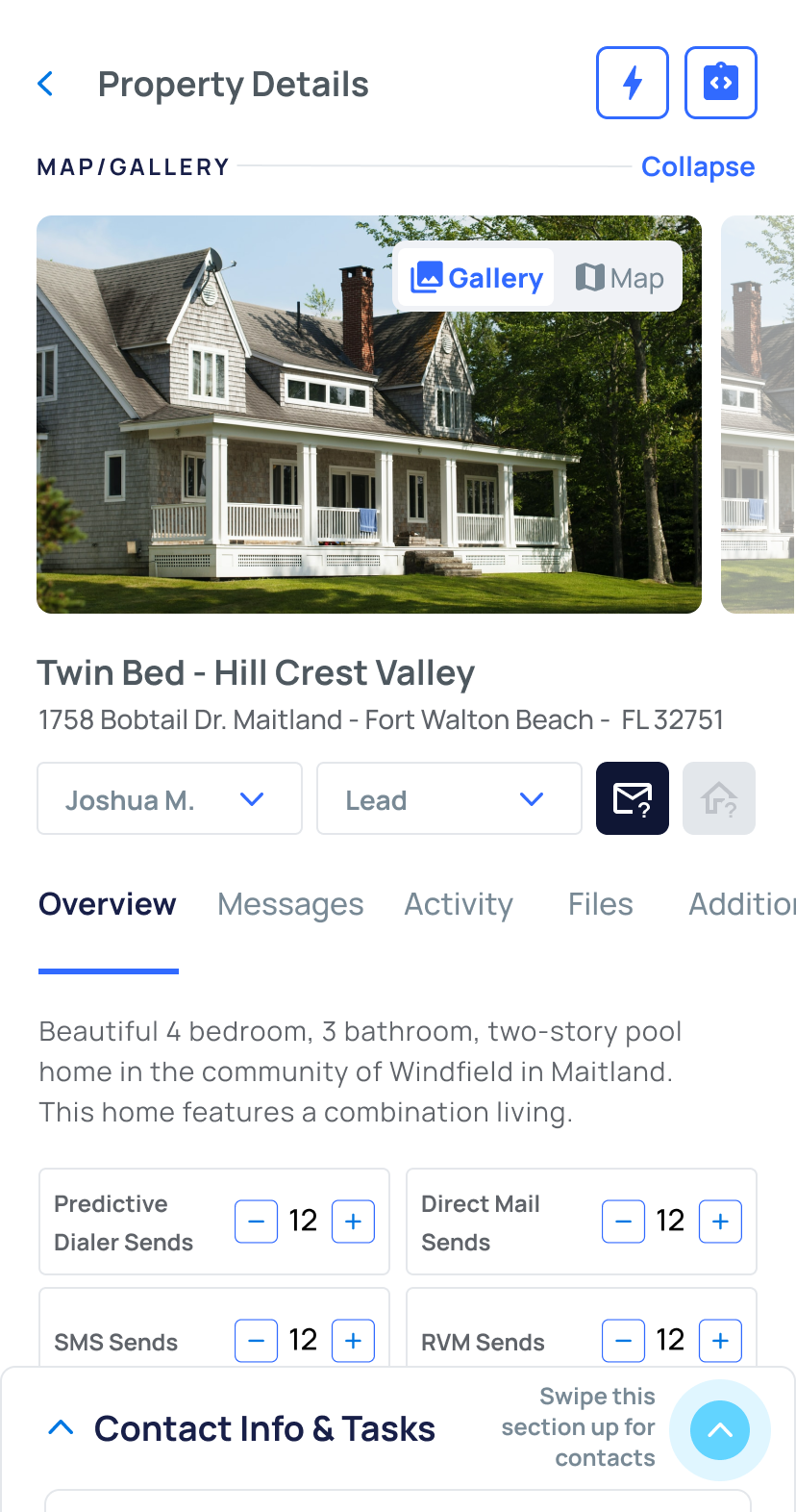
Property page
Page with the most needed/used pieces of information about the property and its owner.
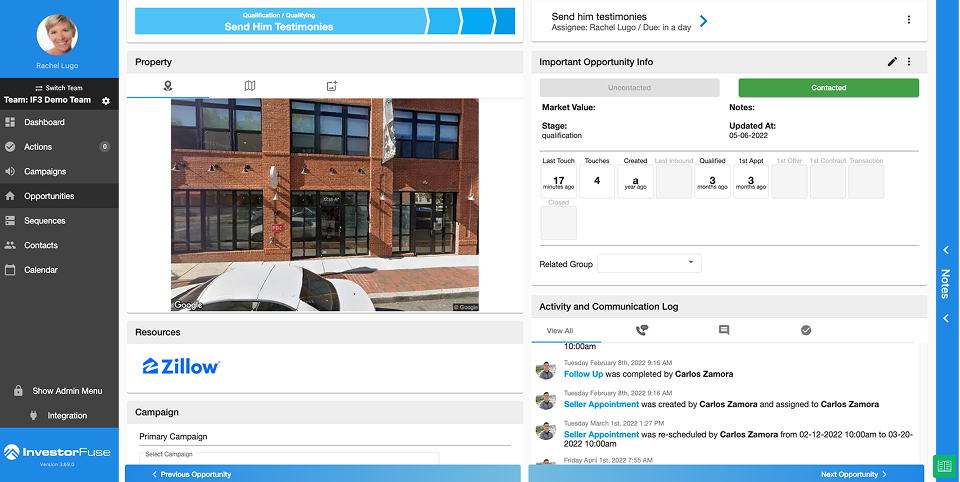
DEAL VIEW
Streamlined version of the deal, detailing the interaction with the lead, from the marketing phase all the way until the signing of the contract.
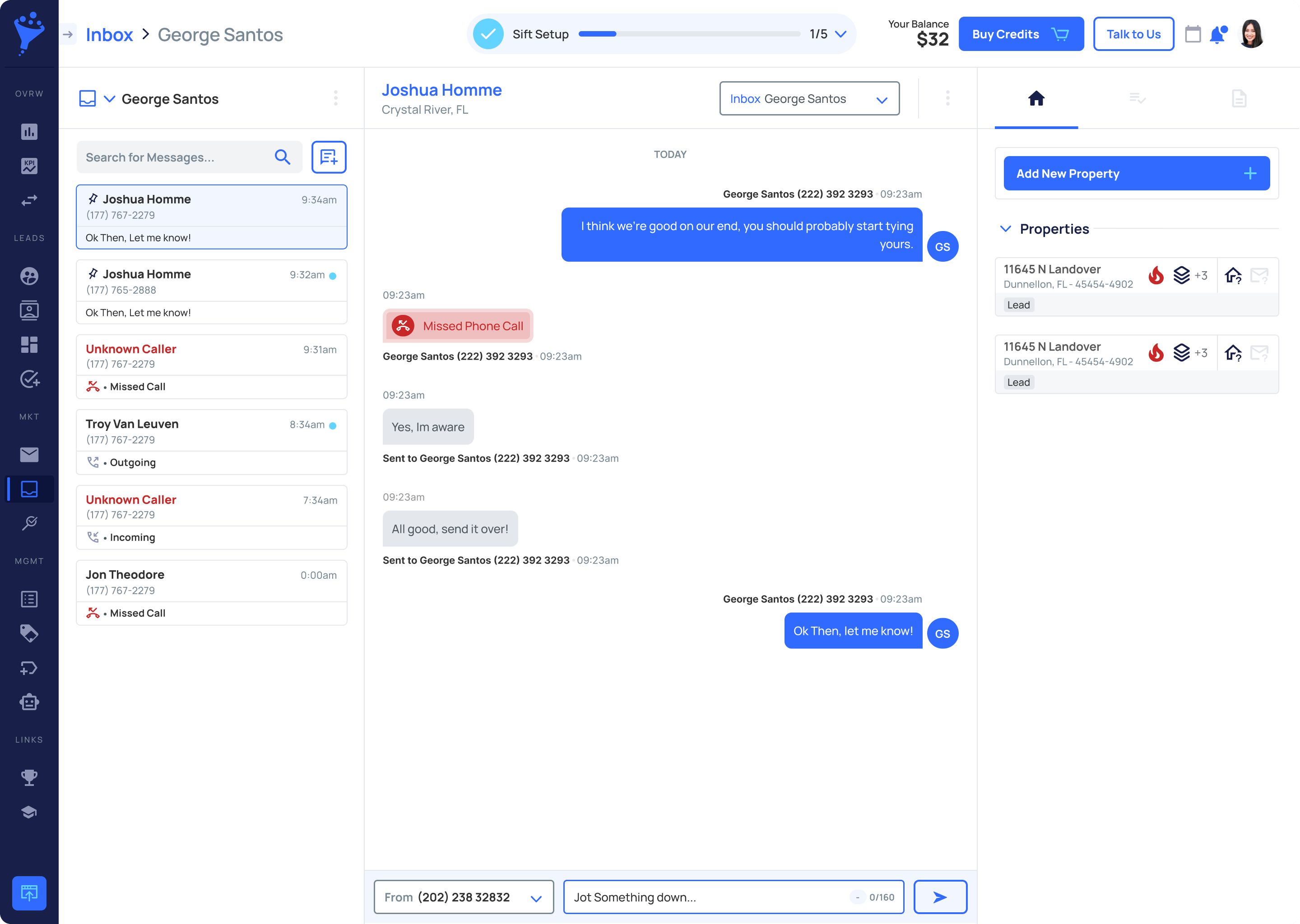
Inbox
Unified SMS and Email inbox with automated marketing workflows.
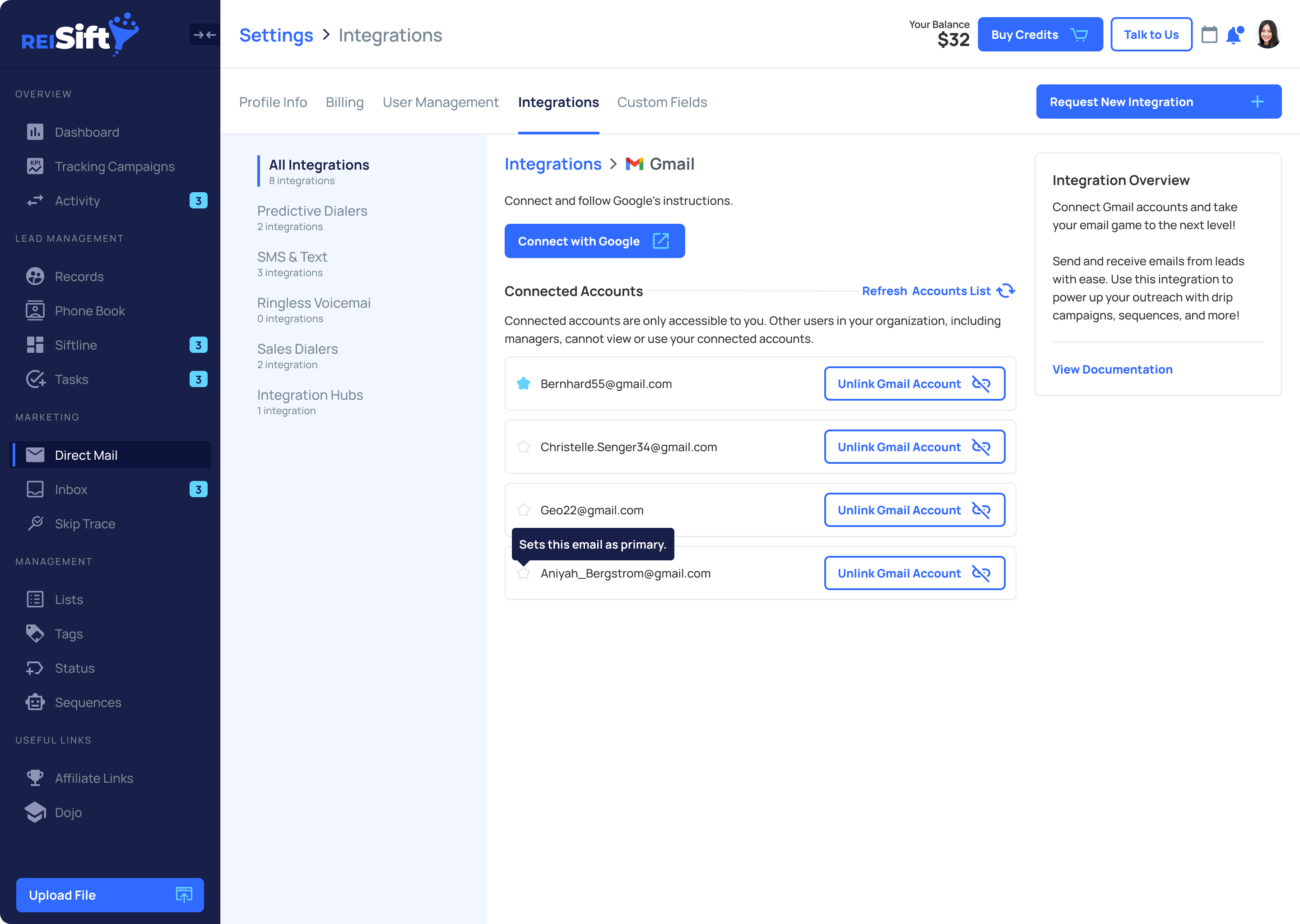
INTEGRATIONS
Internal Integrations marketplace with instructions on how to connect and use the connected partners and a form to gauge interest on different integrations.
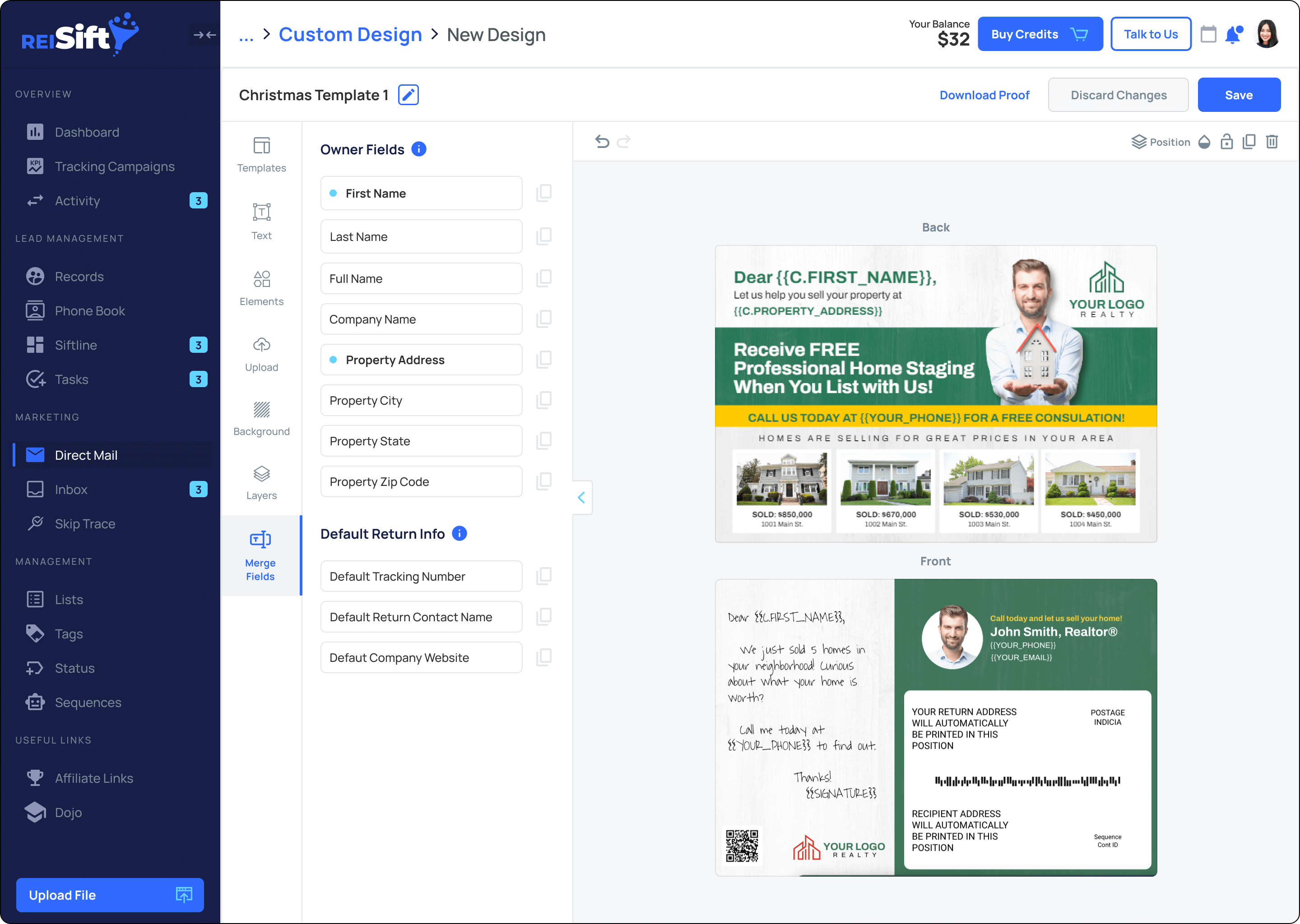
Direct mail
Mail template tool for designing and sending physical postcards and letters to leads directly from the platform.
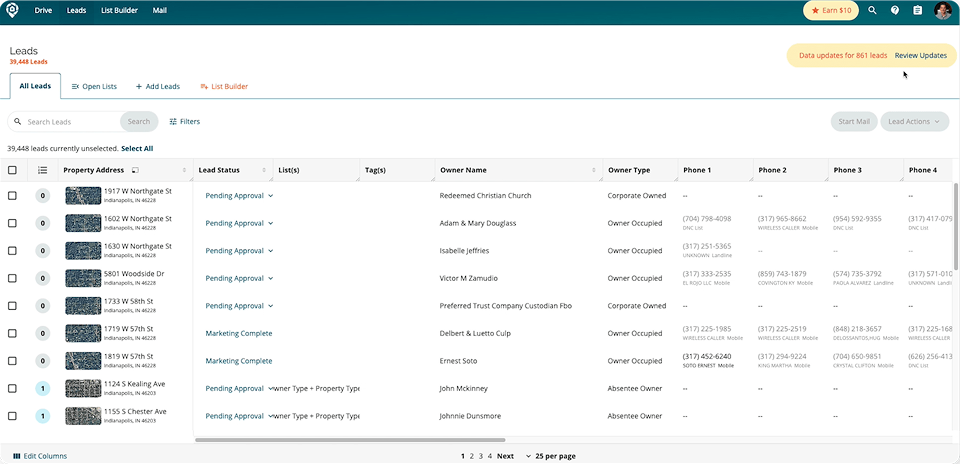
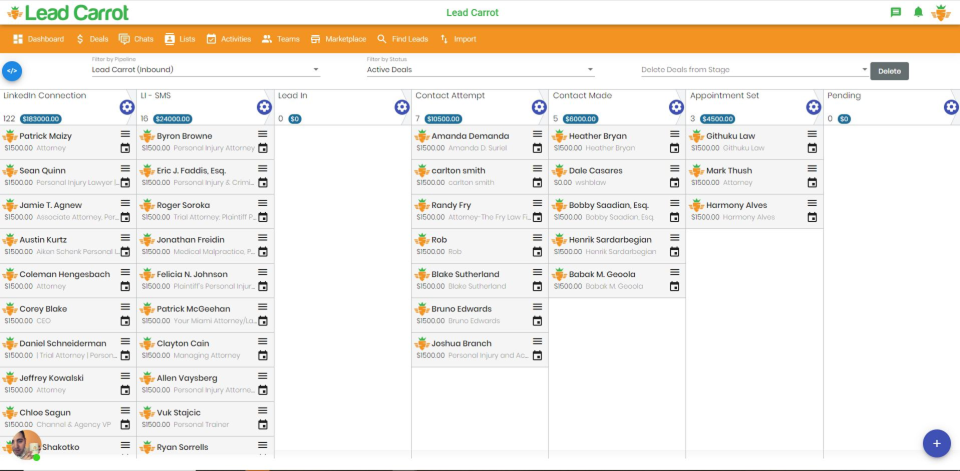
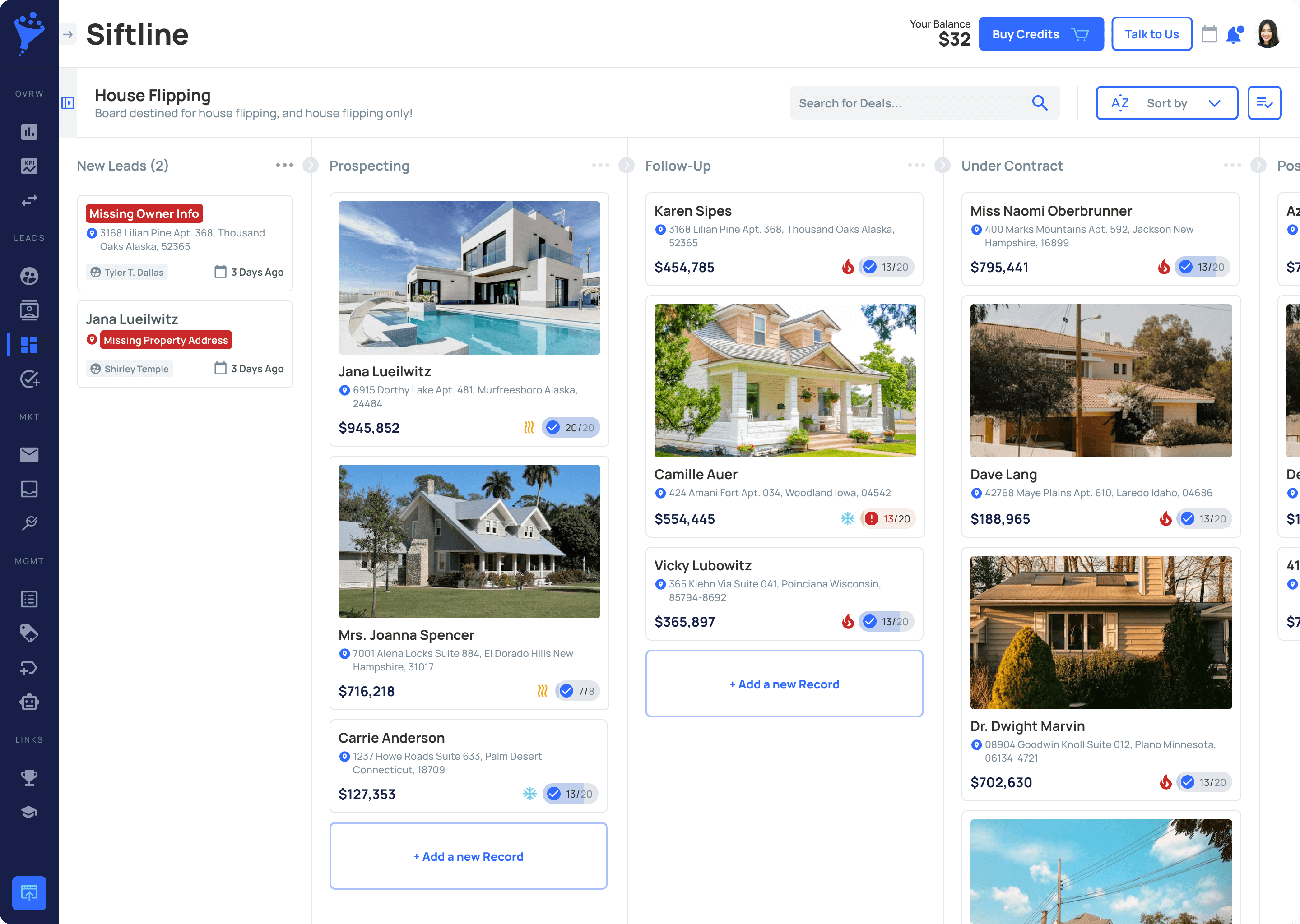
lead management
Kanban board for managing leads, with new contacts automatically added through marketing channels like SMS, direct mail, and cold calling.
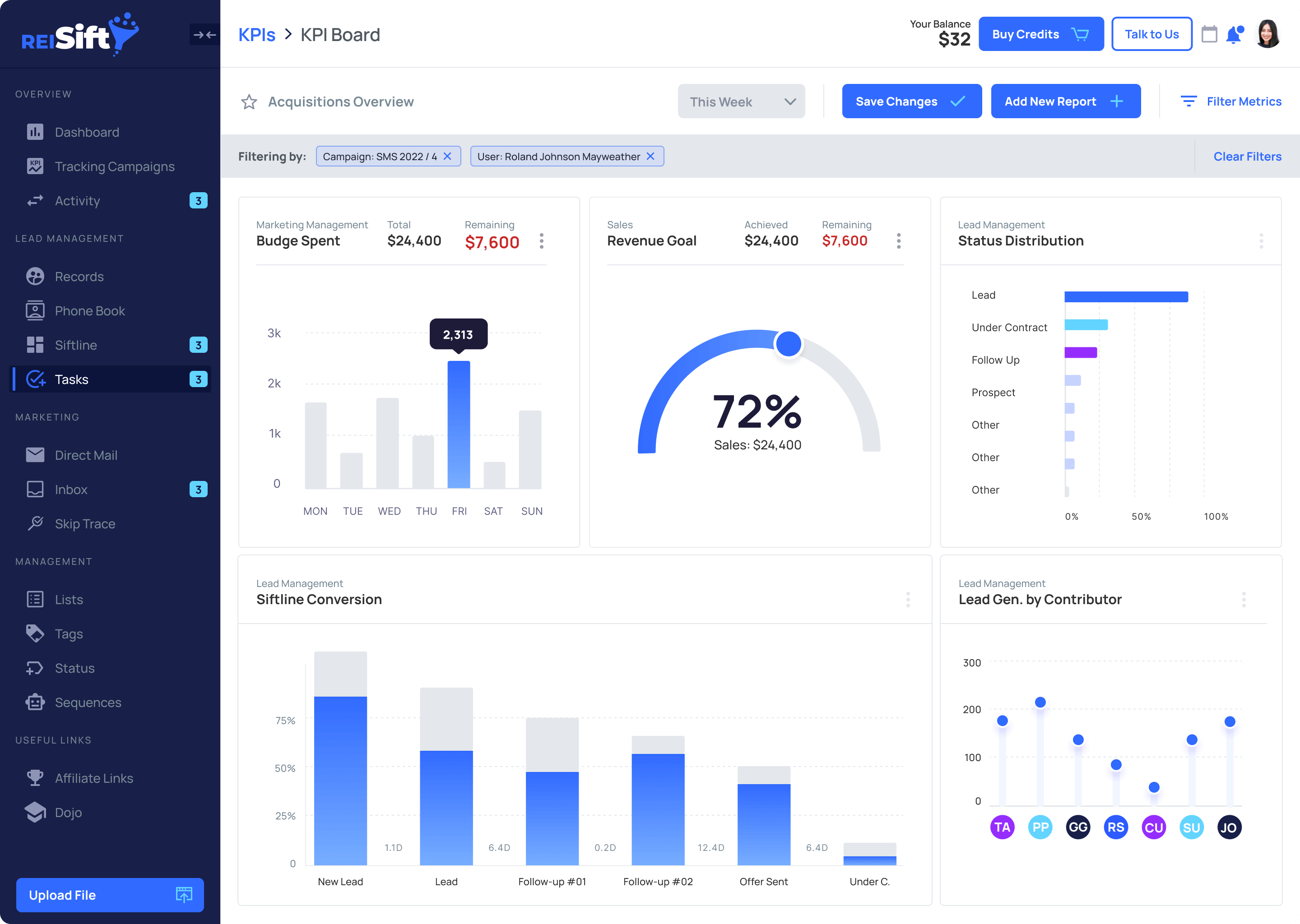
KPI BOARD
Increase the volume and quality of user reviews to boost conversion rates, leverage social proof, and influence purchasing decisions.
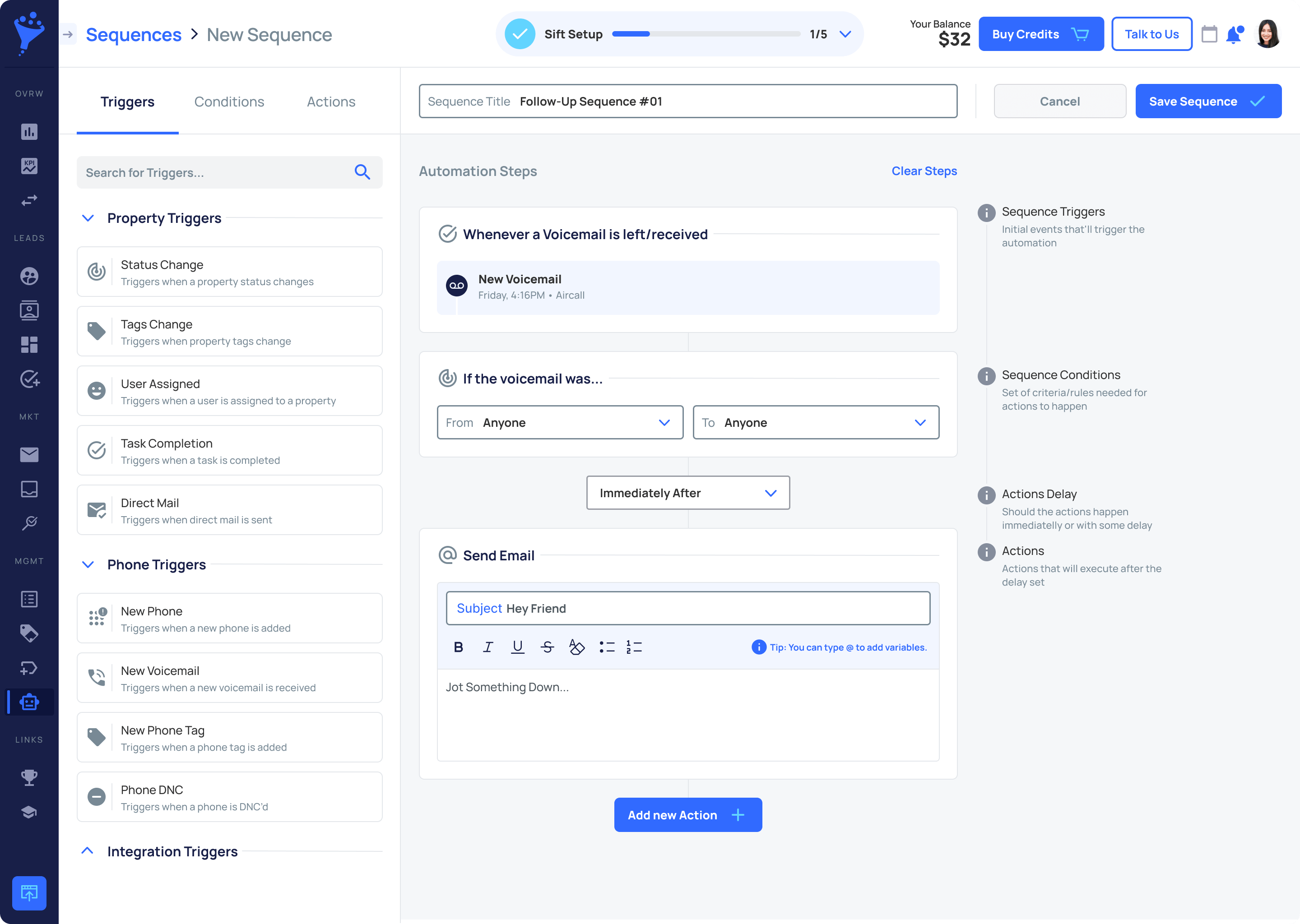
AUTOMATION
Rule-based automation using triggers, conditions, and actions to respond to system changes, like sending an SMS message or submitting an offer when specific criteria are met.
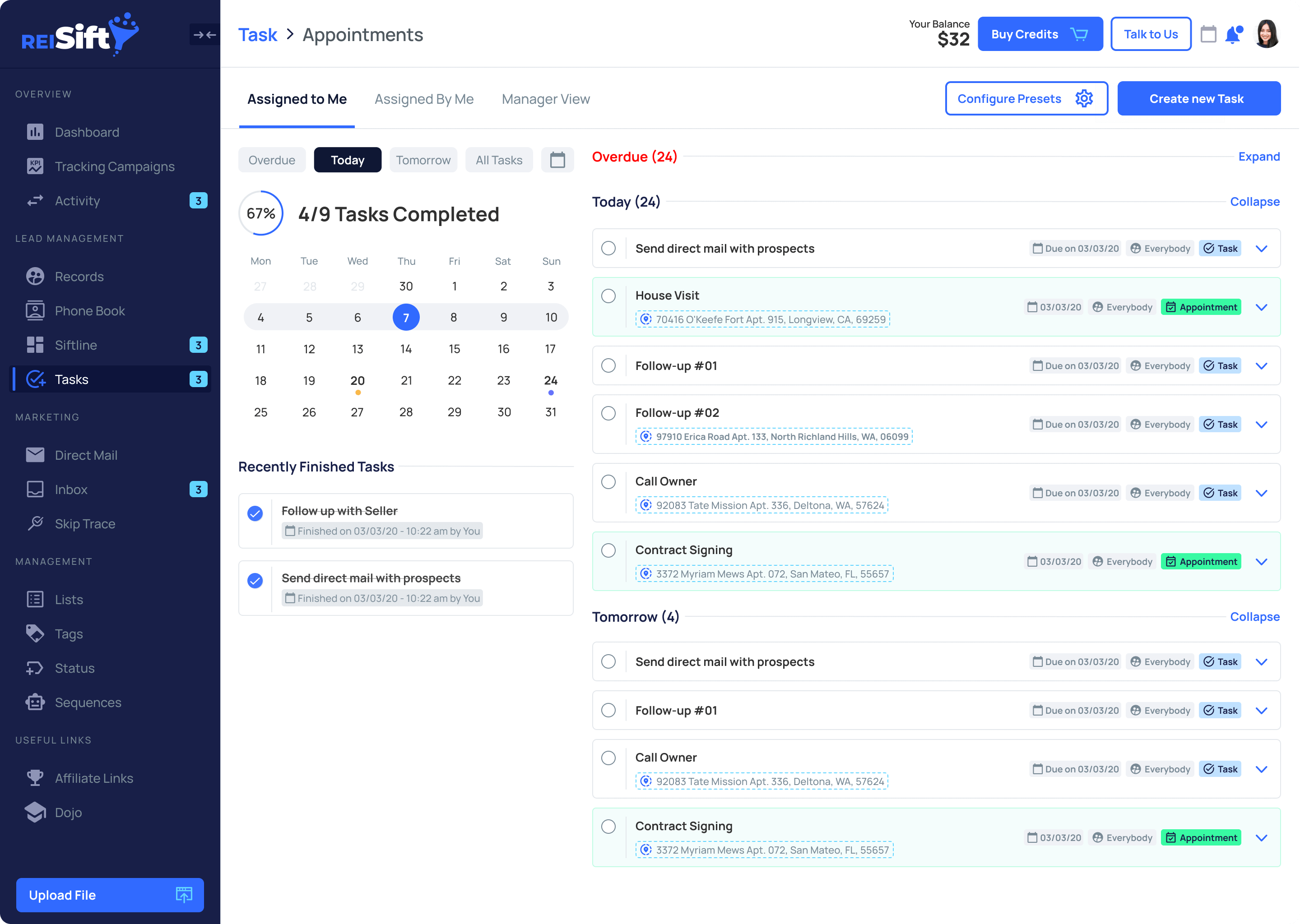
TASKS
Task and apointment management tied to properties, owners, or deals, keeping action items organized within their relevant context.

Intentional Interactions

Small interface moments carried significant weight. Button hover states, tooltip timing, and micro-animations weren't decorative. They guided users through new features and reinforced familiar processes. These subtle cues helped investors navigate the platform without constant explanation, making complex workflows feel more approachable.

Mobile Solution

The mobile interface wasn't a direct translation of the desktop version. Heavy data tables and complex workflows were adapted rather than shrunk, presenting only the information investors needed while on the go.

This approach prevented overwhelming mobile users with desktop complexity that didn't translate well to smaller screens.

Some features, like drive-for-dollars, resulted in exclusive native mobile apps designed specifically for field use.
IMPACT

The Results

Each feature added stability to the business. The mail template tool reduced dependency on external services, keeping users inside the platform longer. SiftLine's automated lead capture turned marketing efforts into organized pipelines without manual work. Automation flows eliminated repetitive tasks that previously drove users to competitors.

In July 2025, REISift was acquired. The acquisition validated not just the feature set, but the approach: building iteratively with users, measuring constantly, and growing without external pressure to scale prematurely.
12
FEATURES
1500
ACTIVE ACCOUNTS
500K
MONTHLY GROWTH
Exit!
Company aquired

What I learned from this project

This project transformed Walmart’s review template into a scalable, user-friendly tool that increased engagement and improved data collection. The scalable design ensured long-term adaptability while supporting the company’s broader strategy for better user insights.
Spec Before Design
Writing feature specifications before opening Figma made iteration faster and cheaper. Stakeholders could debate functionality in paragraphs instead of polished mockups. By the time design started, the hard decisions were already made.
Minimum Viable Doesn't Mean Incomplete
New features needed to be good enough that users would immediately abandon their third-party tools. Half-built solutions just added to the fragmentation problem. Each feature had to earn its place by genuinely improving on what investors were already using, strengthening the platform's value proposition with every release.
A TIGHT COMMUNITY GOES A LONG WAY
The beta group, engaged power users, and free learning bootcamps created more than feedback channels. They built investment in the product's success. Users didn't just report bugs, they championed features to peers. This provided validation, caught issues early, and became the platform's most effective marketing.
Instrument Everything From Day One
Mixpanel and Hotjar weren't added later, they were foundational. Tracking every interaction from the start meant decisions were based on behavior, not assumptions. Usage patterns showed which features actually mattered. Without this data infrastructure, the platform would have been built on guesswork.